Small-angle neutron scattering (SANS) measurements at the Budapest Neutron Centre (BNC) have helped researchers investigate how medieval potters shaped their vessels. Published in Archaeological and Anthropological Sciences, the study examines greyware and redware ceramics produced in Utrecht, the Netherlands, between the 12th and 15th centuries.
The international research team combined compositional analyses with investigations of pottery-forming techniques to reconstruct different stages of ceramic production. BNC’s contribution focused on SANS measurements of 38 pottery fragments, carried out on the YS-SANS instrument. Significantly, as the method is non-destructive, the sherds could be examined without sampling.
Using a methodology developed by the Heritage Science Group at the BNC specifically for the analysis of ancient pottery, SANS may be used to provide information about the orientation and alignment of nanoscale structures within ceramic fabrics, which can preserve evidence of the forces applied during shaping. By comparing these measurements with experimental reference samples and with visible features of the pottery, the researchers were able to assess how the vessels were formed.
The findings indicate that percussion-based hand-forming followed by secondary wheel-shaping remained the predominant technique in both production phases examined by SANS. Wheel-throwing was also identified, but only in samples from the later phase.
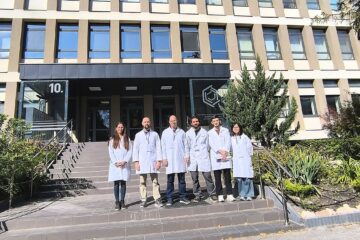
With BNC researchers John Gait, Katalin Bajnok and Adél Len among its co-authors, the study highlights how neutron scattering can contribute to our understanding of past craftsmanship and technological change.
Read the open-access article:
Advancing the chaîne opératoire analysis of medieval greyware and redware ceramics: A case study from 12th to 15th centuries CE Utrecht, the Netherlands